

Local Polished Concrete Installation Costs and Finishes
What if the finish matters as much as the concrete beneath it? A local polished concrete installation in Cardiff can be tailored from a restrained matt look to a high-gloss surface: the concrete is smoothed with progressively finer diamond abrasives, with polishing stages ranging from 50 to 3,000 grit.
It’s reasonable to want a clear idea of how the floor will look, what the work involves and what could affect the budget before deciding. This guide explains polished concrete, compares the main finish options and outlines the factors that shape project costs.
The price depends on the project and is provided after a quote request. Floor area, the existing surface, preparation needs and chosen finish all influence the cost. You’ll also learn what to consider for installation in Cardiff and how to plan the work around the property and its requirements.
Table of Contents
What is polished concrete?
Polished concrete is a finished concrete surface refined through grinding and polishing. Its appearance and performance depend on the substrate, preparation and finish specified for the room.
Floor characteristics and specification
A floor survey considers the existing concrete, its condition, level and intended use. A living area may suit a different sheen and aggregate exposure from a busy commercial space. The specification sets the desired colour, surface appearance and polishing level, while allowing for repairs and preparation. This helps match the finish to the room rather than treating every concrete floor alike.
Grinding and professional installation
Professional installation begins with assessing the substrate and preparing the surface. Diamond abrasives remove imperfections and progressively refine the concrete; polishing can use pads from 50 to 3,000 grit. The selected process determines how much aggregate shows and how reflective the floor becomes. Preparation may involve clearing debris, levelling and addressing drainage or reinforcement needs before concrete is placed. Careful curing supports the floor’s long-term performance.
Unlike microcement, resin and polished porcelain, polished concrete uses the concrete surface itself as the finish. Epoxy resin creates a distinct floor finish and can also be applied to worktops, but it is not the same process as polishing concrete. For homeowners considering alternative finishes for outbuildings or utility areas, residential transformation specialists like The Garage RX illustrate how durable floor coatings and bespoke organisation work together to modernise utilitarian spaces.
When choosing a local polished concrete contractor, look for a clear survey, a written finish specification and an explanation of preparation, grinding and curing. Subfloor preparation depends on the existing surface. The professional assesses its condition, removes debris, levels where needed and plans any repairs before polishing.
There isn’t one polished-concrete rule for every property. Whether building-control or planning considerations apply depends on the wider project and the property’s circumstances.
Kitchens and bathrooms can have polished concrete floors, but the specification should suit the room’s use and surface requirements. Underfloor heating needs consideration alongside the concrete build-up and installation. Maintenance includes periodic resealing; a correctly installed and maintained floor can perform for 25 to 30 years or more. Cracking is a possible risk because concrete has relatively low tensile strength, according to the University of Illinois Urbana-Champaign.
Light, salt-and-pepper and full-aggregate finishes
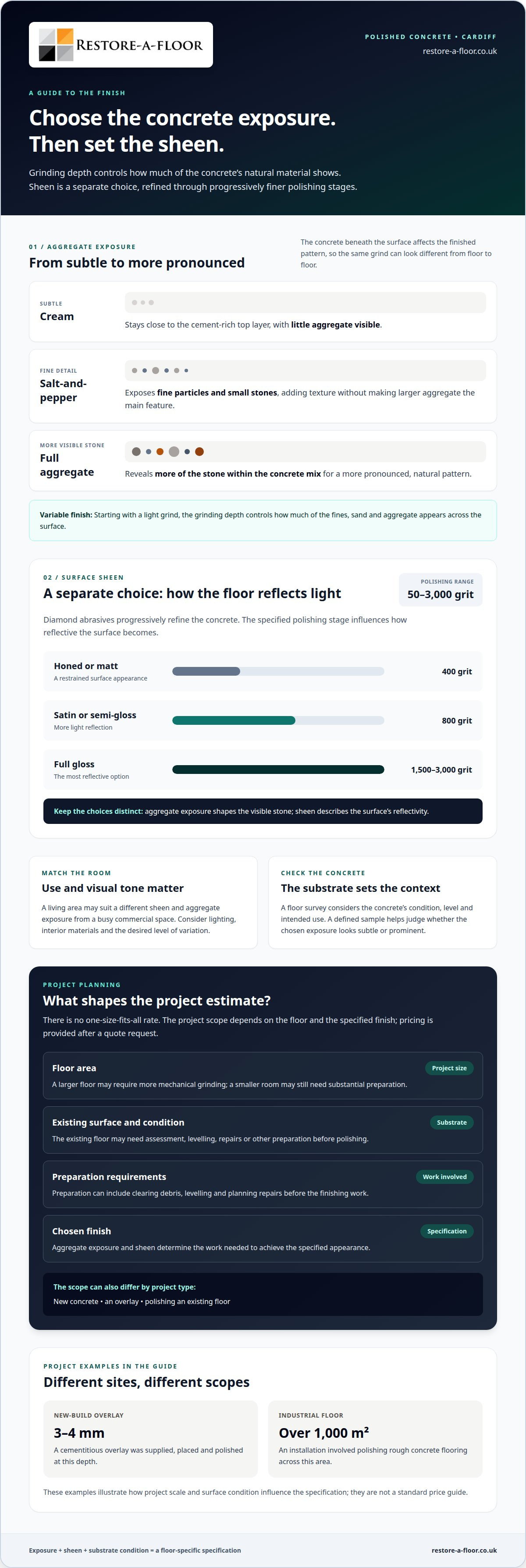
The depth of the grind controls how much of the concrete’s natural material shows through. Choose aggregate exposure and sheen together to shape the floor’s character, from subtle to striking.
Cream and aggregate exposure
A cream finish stays close to the concrete’s cement-rich top layer, with little aggregate visible. Salt-and-pepper exposes fine particles and small stones, adding texture without making larger aggregate the main feature. A full-aggregate finish reveals more of the stone within the mix. The right choice depends on your preferred look and the concrete beneath it, since the material affects the finished pattern.
Variable finishes and light grinding
A variable finish starts with a light grind. The grinding depth then controls how much of the fines, sand and aggregate appears across the surface. This can create a restrained, seamless look or reveal more natural variation. It suits projects where the desired character comes from the concrete itself rather than a uniform covering. The floor’s condition and the chosen exposure guide the specification.
For retail and hospitality spaces, the finish helps set the room’s visual tone. A lightly ground cream surface can create a quieter backdrop, while exposed aggregate gives a more pronounced, industrial character. Consider the lighting, interior materials and desired level of visual variation before choosing the grind. A defined sample makes it easier to judge whether the exposure is subtle or prominent.
Sheen is a separate choice from aggregate exposure. A honed or matt finish is described as 400 grit; satin or semi-gloss is 800 grit. Full gloss uses 1,500-3,000 grit. Each stage refines the surface, changing how it reflects light. Sealing can form part of concrete floor finishing, alongside polishing or specialist coatings, depending on the specified system.
For a finish tailored to the room, discuss the concrete’s appearance and intended use as part of professional concrete floor polishing. Defining the aggregate exposure and sheen at the specification stage helps keep the desired look consistent from start to finish.
Project costs and installation coverage
Concrete floor budgets depend on the area, substrate and finish, so a single rate cannot describe every project. In Cardiff, the scope also depends on whether the work involves new concrete, an overlay or an existing floor.
Polished concrete project examples
Project examples show how different sites shape the work. One new-build project used an external cementitious overlay supplied, placed and polished at a depth of 3-4 mm. An industrial installation involved polishing over 1,000 square metres of rough concrete flooring. Commercial and industrial specialists such as polishedconcreteatlanta.com demonstrate how mechanical grinding and tailored polishing systems are scaled to handle expansive, heavy-duty facilities. These examples illustrate how project scale and surface condition influence the specification.
For restaurants or retail spaces, photos are most useful when they show a comparable setting and finished surface. A review that describes the project, preparation and result gives more context than a general rating alone. Look for clear examples of colour, aggregate exposure and the floor’s appearance across the whole space.
Project size and pricing approach
Area is one part of the estimate, not the only one. A larger floor may require more mechanical grinding, while a smaller room can still need substantial preparation if the substrate requires attention. The design matters too: the chosen finish determines the work needed to expose aggregate or achieve a particular sheen. Compare project scopes, not just square metres.
Polished concrete is described as competitive with mid-range porcelain tiling on a per-square-metre installation basis. This comparison doesn’t establish a quote for a specific property, as preparation and specification still shape the final scope.
Project costs and cost drivers
The price depends on the project and is provided after a quote request. Key cost drivers include floor area, the condition of the existing concrete, access, preparation, repairs, overlay requirements and the selected finish. Colour choices and the degree of aggregate exposure can also affect the specified process.
Reviews and project photos can help illustrate a local polished concrete installer’s completed work. A useful project record connects the client’s brief with the finished floor, showing the setting, finish and scale. This makes it easier to judge whether the examples match the needs of your Cardiff project.
Polished concrete installation in Cardiff
Cardiff projects range from residential rooms to busy showrooms, and each floor needs a specification suited to its setting. Area, substrate, aggregate exposure, curing and final coating all influence how the work is planned.
For an existing residential substrate up to about 100 m², a standard polished concrete floor typically takes 2-4 days to complete. Larger or more complex projects can take several days, depending on their size, curing time and finishing requirements. These timings describe different project scopes, not a fixed programme for every Cardiff property.
Installation starts with a survey of the concrete and surface preparation. The specification then sets the desired colour, aggregate exposure and sheen. Grinding and polishing refine the floor, followed by any specified finishing treatment. Proper curing helps prevent cracking and supports long-term floor performance, so the programme must account for the concrete’s condition and finishing process.
Consider underfloor heating during project planning, alongside the substrate and floor build-up. This lets the installation specification account for the heating system and intended finish. For showrooms, restaurants or homes, a written specification is highly recommended. It records the selected aggregate exposure, sheen and coating, helping keep the completed appearance aligned with the agreed design.
After a penetrating guard sealer is applied, polished concrete floors can be walked on within a few hours. This milestone doesn’t mean every installation stage is complete: the full programme still depends on curing and finishing requirements. Regular maintenance, including periodic resealing, helps preserve the surface over time.
For Cardiff property owners, local polished concrete installation means planning around the actual floor, not simply choosing a finish from a photograph. Share the project setting, existing substrate and preferred appearance to shape the specification. Discuss concrete floor polishing for your Cardiff project.
Restore-A-Floor: Concrete Floor Polishing
Restore-A-Floor provides concrete floor polishing for homes and commercial spaces in Cardiff, shaping the specification around the existing floor, intended use and chosen finish. Choose this service when planning a new polished surface or transforming existing concrete. Preparation and polishing are considered as part of the project, with attention to the final appearance and the room’s requirements.
Before work begins, the floor’s condition and desired result guide the approach, including the level of aggregate exposure and sheen. This helps align the finished surface with your plans for the space. If you’re comparing concrete with other flooring, Restore-A-Floor also provides parquet floor supply and installation, wood floor sanding and refinishing, and tiled floor restoration and cleaning.
Contact Restore-A-Floor to discuss concrete floor polishing for your project.
Plan a floor that fits your space
The next step is to turn your preferred look into a clear project brief. For a local polished concrete installation, outline the room’s purpose, the condition of its floor and the finish you want. These priorities can guide the project discussion and specification.
Restore-A-Floor provides concrete floor polishing, wood floor sanding and refinishing, and parquet floor supply and installation. If you’re still weighing up flooring options, these services offer different ways to shape the character of a space. Start with what matters most to you: the surface, the overall appearance or the floor material.
Share your project requirements and discuss the next step with Contact Restore-A-Floor today. A considered brief gives your flooring project a clear direction, so you can move ahead with confidence.
Frequently Asked Questions
Why is curing important for concrete floors?
Curing manages moisture while concrete gains strength, helping reduce cracking and support long-term floor performance. The concrete needs suitable curing conditions before later finishing stages proceed. This matters particularly where the floor’s appearance depends on careful grinding and polishing, since cracks or weak areas can affect the finished surface. The project plan should account for curing, rather than treating it as an optional pause.
Will the finish look the same throughout my home or will it vary?
The finish can vary between rooms because the concrete surface and aggregate exposure influence its appearance. A hallway with existing concrete may reveal different material from a newly laid room, even under the same broad finish specification. Agreeing on the intended look for adjoining spaces helps create a coherent design. A sample viewed at home can help you assess colour and sheen together.
What is the process for installing a polished concrete floor?
Installation typically progresses from site preparation to concrete placement, curing and final surface finishing. Preparation can include clearing debris, levelling the ground and installing necessary formwork. Machinery distributes and levels poured concrete, while careful pouring helps avoid weak spots or air pockets. Once the concrete has cured appropriately, grinding and polishing refine the surface to the specified appearance.
How long does polished concrete installation take?
A standard residential polished concrete floor on an existing substrate typically takes 2-4 days to complete for a floor up to about 100 m². That timeframe describes this particular project type, not every installation. New concrete, a larger area or more involved finishing requirements affect the programme. Curing also needs to be included in planning, so the work schedule reflects the floor’s construction and finishing stages.
What are the different polished concrete finishes, colours and aggregate options?
Options include cream, salt-and-pepper and exposed-aggregate appearances, as well as matt, satin and gloss sheens. Concrete floor finishes can also include colour for a more tailored look. Aggregate exposure affects how much of the stone in the concrete is visible, while sheen changes how the surface reflects light. Consider these choices together, then review a sample to see how they work with your room’s materials and lighting.
Find local polished concrete installers near me with reviews and project photos
When choosing a local polished concrete installer, look for reviews and project photos showing comparable settings, preparation and finished surfaces. A clear project record helps you judge whether the work matches your requirements.
Comments