

Cost of Polished Concrete Floor Cardiff: A Comprehensive Buying Guide
- info089907
- 5 days ago
- 12 min read
Did you know that nearly one in four high-end kitchen extensions in the UK now features a polished concrete floor instead of traditional tiling? This shift reflects a growing preference amongst homeowners for architectural durability and long-term value over temporary aesthetic fixes. It's understandable if you feel frustrated by the lack of transparent pricing whilst researching the cost of polished concrete floor Cardiff projects. Many people find themselves caught between confusing technical jargon and vague estimates that don't account for the unique condition of their property's sub-floor or the specific requirements of Welsh building standards.
This guide provides the clarity you need by detailing the factors that determine your final investment, from the desired level of aggregate exposure to the technical state of your existing substrate. You'll learn the critical differences between genuine mechanical polishing and topical overlays, ensuring you invest in a solution that lasts for decades. We also outline how to prepare your space to manage expenses effectively and explain how the 2026 building safety regime in Wales affects your responsibilities as a client. By the end, you'll have the confidence to select a local specialist who delivers a precision finish tailored to your Cardiff home.
Table of Contents
Understanding the Cost of Polished Concrete in Cardiff
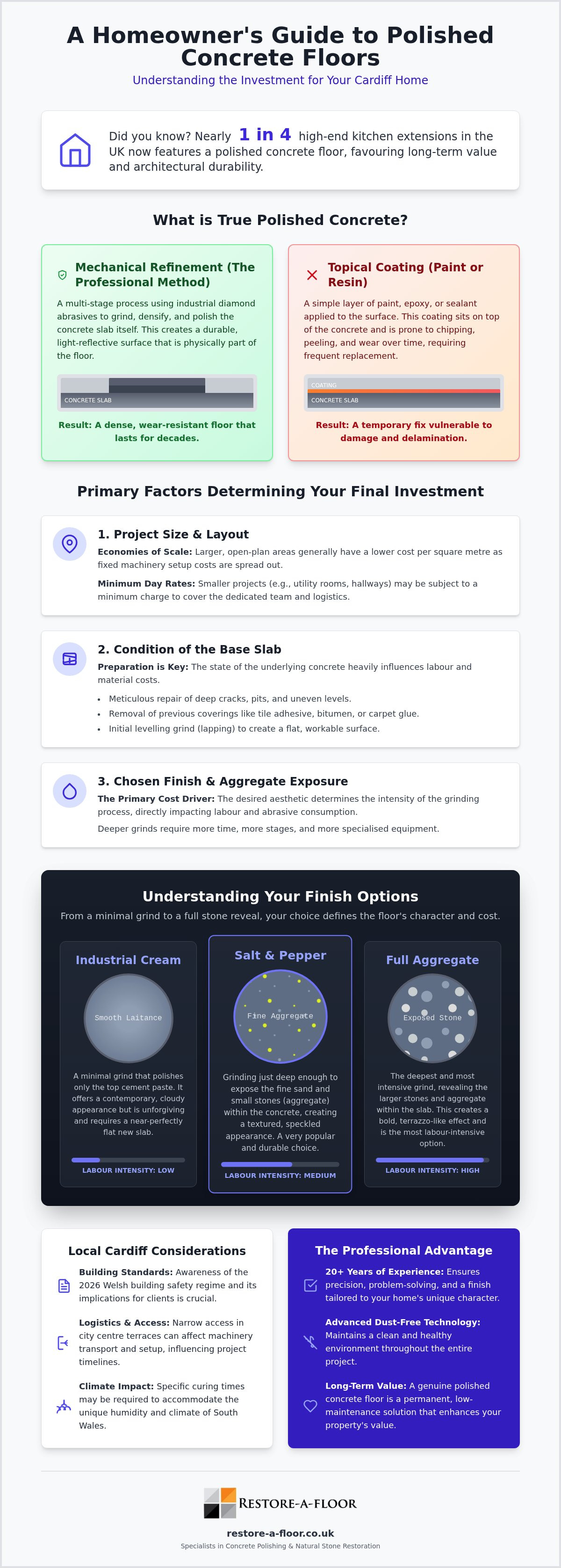
Investing in a high-end floor requires a thorough understanding of what polished concrete is: a multi-stage mechanical refinement process rather than a simple topical coating. Unlike paints or resins that sit on the surface, true polished concrete involves grinding the substrate with industrial diamonds to achieve a dense, light-reflective finish that is physically part of the slab. This technical complexity means that the cost of polished concrete floor Cardiff homeowners encounter is rarely a "one size fits all" figure. Whilst a headline rate per square metre provides a useful baseline, your final investment is dictated by three primary pillars: the intensity of the preparation required, your chosen level of aggregate exposure, and the total area of the project. Choosing this path offers significant long-term savings, as the resulting surface is incredibly durable and eliminates the cycle of replacing worn carpets or cracked tiles every few years.
The Impact of Square Footage on Pricing
Large-scale projects often benefit from economies of scale. In commercial environments, the cost per metre tends to decrease because the fixed expenses of transporting heavy machinery and setting up specialised dust-extraction systems are spread across a greater area. Conversely, smaller residential projects in Cardiff, such as a compact utility room or hallway, may be subject to minimum day rates. This reflects the time required for the machinery to navigate tight corners and the logistical reality that a specialist team is dedicated to your site for the duration of the work. When calculating the cost of polished concrete floor Cardiff residents should consider that open-plan layouts are generally more cost-effective than multi-room configurations. Open spaces allow for uninterrupted passes with larger grinding equipment, which significantly reduces the labour hours required to achieve a uniform finish.
Condition of the Base Slab
The state of the underlying concrete significantly influences the labour hours required and the volume of diamond abrasives consumed. If your existing floor is marred by deep cracks, pits, or uneven levels, these defects must be meticulously repaired and stabilised before the polishing stages begin. Removing previous floor coverings, such as stubborn tile adhesives, old carpets, or bitumen, adds another layer of technical preparation that must be accounted for in the initial budget. Lapping is the initial grinding phase used to level the concrete surface and remove high spots before the refinement stages begin. Addressing these substrate issues early ensures the final aesthetic is flawless and prevents premature wear, ultimately protecting your investment by reducing the need for future maintenance or replacement costs.
Price Breakdown by Finish: Level of Aggregate Exposure
The aesthetic character of your floor is defined by how much of the internal stone, or aggregate, is revealed during the grinding process. This technical choice is a primary driver for the cost of polished concrete floor Cardiff clients should budget for, as deeper grinds require significantly more labour and industrial diamond abrasives. Beyond the visual appeal, every professional refinement includes densification. This chemical stage involves applying a liquid hardener that reacts with the free lime in the concrete to create a denser, more abrasion-resistant surface. Higher sheen levels, ranging from a subtle matte to a mirror-like high gloss, also influence the final investment due to the additional polishing passes required to close the surface pores and achieve maximum light reflectivity.
The Industrial Cream Finish
Often regarded as the most contemporary and "natural" aesthetic, a cream finish involves polishing only the very top layer of the concrete, known as the laitance. It's an excellent, budget-friendly option for newly poured slabs of exceptional quality where a uniform, cloudy appearance is desired without exposing the underlying stones. However, this finish is unforgiving. It requires a near-perfect power-trowelled surface, as any existing imperfections, footprints, or unevenness in the pour will remain visible. If your substrate doesn't meet these stringent criteria, a deeper grind might be necessary to achieve a professional result.
Salt and Pepper vs. Full Aggregate Exposure
For those seeking more texture, the "Salt and Pepper" finish involves a medium grind that removes approximately 1mm to 2mm of the surface to reveal fine sands and small stones. This medium-tier refinement typically represents a middle ground for the cost of polished concrete floor Cardiff residents expect, balancing visual impact with labour intensity. In contrast, Full Aggregate Exposure is the most premium tier. This process involves removing up to 5mm of the concrete surface to showcase the larger stones in their entirety, creating a look reminiscent of traditional terrazzo. According to technical guidelines from The Concrete Society, achieving this level of uniformity requires meticulous precision and high-performance machinery to ensure the stones are cut cleanly rather than dislodged.
The volume of concrete removed during a full exposure project naturally increases the man-hours and waste management requirements. This intensive process creates a striking architectural feature that is particularly well-suited to high-end residential designs in South Wales. If you're unsure which level of refinement suits your property's existing slab, seeking a professional concrete floor polishing assessment can clarify the most viable options for your specific budget and aesthetic goals.
Polished Existing Slabs vs. New Concrete Overlays
The decision between refining an existing slab and installing a new overlay is a pivotal moment in any renovation project. Whilst polishing an original floor is generally the most cost-effective route, success depends entirely on the structural integrity and aesthetic quality of the concrete already in place. In many Cardiff properties, particularly those with a history of multiple renovations, the base slab may be uneven, contaminated with old adhesives, or comprised of a soft, non-polishable screed. Professional sub-floor preparation is essential here; skipping this stage to save on the initial cost of polished concrete floor Cardiff projects often leads to reflective cracking or delamination later on.
The UK's concrete industry provides clear technical standards for what constitutes a "polishing grade" slab. If your current floor falls short of these benchmarks, a micro-cement or polished overlay becomes the logical alternative to ensure a premium result. These systems allow you to achieve the architectural aesthetic of concrete even when the underlying substrate is compromised or unsuitable for heavy mechanical grinding.
When to Choose a Concrete Overlay
Overlays are specialised toppings that provide a perfectly consistent colour and finish, bypassing the unpredictable nature of an old slab. These systems typically require a depth of 10mm to 15mm, which means you must account for the height of door thresholds and skirting boards during the planning phase. Whilst there is a price premium for the high-performance polymers and pigments used in these materials, they offer a level of aesthetic control that raw concrete cannot match. This makes them ideal for modern Cardiff extensions where a specific, uniform tone is required to complement a minimalist interior design.
Restoring Historic Slabs in Cardiff
Managing the complexities of Cardiff's older housing stock requires a specialist eye. Many Victorian or Edwardian homes in the city have sub-floors that have been buried under decades of bitumen, vinyl tiles, or damp-proof membranes. Grinding through these layers is technically demanding and requires industrial-grade equipment to reach the workable concrete beneath. With over 20 years of experience in the region, Restore-A-Floor identifies whether a historic slab is a candidate for restoration or if it requires a more modern intervention. For a deeper look into the technical stages involved in this transformation, consult our Ultimate Guide to Polished Concrete, which details the meticulous grinding and sealing processes we employ. Understanding these variables early ensures the final cost of polished concrete floor Cardiff homeowners pay reflects a durable, high-quality result rather than a temporary fix.
Local Cardiff Factors and Logistics
Local logistical variables play a decisive role in the final cost of polished concrete floor Cardiff residents encounter. In a city as geographically diverse as Cardiff, the physical environment of your property dictates the equipment we deploy and the time required for setup. The local climate, characterised by typical South Wales humidity and temperature fluctuations, directly impacts the curing times for new concrete pours. High humidity can slow the evaporation of moisture, potentially extending the window before mechanical polishing can safely begin. We also consider the availability of local aggregates; sourcing stone from regional quarries allows homeowners to achieve a bespoke finish that reflects the natural geology of the area whilst supporting a more sustainable supply chain.
Access and Equipment Mobilisation
Navigating the logistical constraints of urban areas like Roath, Canton, or the city centre requires careful planning. Narrow Victorian terraces often lack side access, meaning heavy grinding machinery must be carefully transported through the property. If parking is restricted or site access is particularly challenging, it can impact the daily rate due to the increased labour involved in mobilisation. For residential projects in Cardiff, we often utilise high-performance single-phase machinery which is more versatile in domestic settings than the larger three-phase equipment used on industrial sites. A stable and clean power supply is essential for high-precision grinders to ensure the motors run at a consistent RPM for a uniform finish.
Underfloor Heating (UFH) Considerations
Many modern extensions in Cardiff now integrate underfloor heating, and polished concrete is widely regarded as the most thermally efficient partner for these systems. Because concrete has high thermal mass, it absorbs, stores, and radiates heat far more effectively than timber or carpet. This integration influences the cost of polished concrete floor Cardiff homeowners should expect, primarily due to the technical commissioning process. This involves a controlled, gradual increase in floor temperature before and after the polishing stages to stabilise the slab and prevent thermal shock. The presence of heating pipes also dictates a minimum slab thickness and specific reinforcement requirements to manage the expansion and contraction of the material without compromising the finish.
If you are planning a renovation and need professional advice on local logistics, you can request a technical site survey to ensure your project is perfectly prepared.
Why Restore-A-Floor is the Logical Choice for Your Cardiff Project
Selecting a partner for your flooring transformation is a decision that extends beyond the initial headline rate. It is an investment in professional standards and technical longevity. With over 20 years of specialist restoration heritage, we recognize that the cost of polished concrete floor Cardiff residents pay should result in a flawless architectural feature, not a compromise. We don't provide generic, off-the-shelf pricing because we understand that every slab in South Wales possesses unique characteristics. Instead, we offer bespoke solutions tailored to the specific density of your concrete and your desired aesthetic outcome, ensuring a result that is both beautiful and structurally sound.
Dust-Free Grinding and Polishing
One of the primary concerns for homeowners during a renovation is the potential for industrial dust to settle throughout their property. We address this concern directly by employing advanced, HEPA-filtered vacuum systems that are integrated with our grinding machinery to capture particles at the source. This meticulous approach maintains a pristine environment and eliminates the hidden cost of hiring post-project professional cleaners. Our commitment to maintaining a clean workspace is a standard we uphold across all our services, including our professional wood floor sanding in Swansea and our broader South Wales restoration projects. By choosing a dust-free method, you protect your home's air quality whilst ensuring a superior finish that isn't compromised by airborne contaminants.
The Quotation Process
To ensure you receive a transparent and accurate breakdown of the cost of polished concrete floor Cardiff projects, we follow a steady, informative quotation process. Having your approximate square metreage, details of the current floor type, and clear photographs of the area allows us to provide a preliminary estimate with confidence. However, the most reliable way to avoid unexpected costs mid-project is through a professional site survey. During this visit, we assess the slab's hardness and identify any structural repairs required before the refinement stages begin. This methodical preparation ensures your project remains on schedule and within the agreed investment level. To begin your journey toward a high-end, durable finish, book your Cardiff site survey and quotation today and let our experts guide you through the technical refinement of your space.
Achieve a Precision Finish for Your Cardiff Home
Investing in polished concrete is a strategic choice for those valuing architectural permanence and ease of maintenance. As we have explored, the final cost of polished concrete floor Cardiff homeowners invest depends on meticulous preparation, the depth of aggregate exposure, and local logistical nuances. Whether you are refining an existing slab in a Victorian terrace or integrating a new pour with underfloor heating in a modern extension, the technical state of your substrate remains the primary driver of value. Selecting a finish that aligns with both your aesthetic goals and your budget ensures a result that enhances your property's character for decades.
Restore-A-Floor brings over 20 years of excellence in flooring to every project, ensuring your vision is realised with total precision. Our advanced dust-free grinding technology protects your living environment, whilst our bespoke finishes provide a custom aesthetic for both residential and commercial spaces. Don't leave your investment to chance with opaque pricing or generic methods. Request Your Free Cardiff Polished Concrete Quote today to receive a transparent, professional assessment from our seasoned experts. We look forward to helping you transform your space into a durable, light-reflective masterpiece that stands the test of time.
Frequently Asked Questions
How much does polished concrete cost per square metre in Cardiff?
The cost of polished concrete floor Cardiff homeowners encounter is determined by several technical variables rather than a fixed price list. Factors such as the hardness of the concrete, the level of aggregate exposure, and the total square metreage all play a role. Whilst larger open-plan spaces offer better value through economies of scale, smaller projects may attract a minimum day rate to cover the mobilisation of heavy machinery and specialised crews.
Is polished concrete more expensive than high-quality floor tiles?
When comparing the cost of polished concrete floor Cardiff projects to high-quality tiling, the long-term benefits often outweigh the initial outlay. Polished concrete is a permanent structural finish that eliminates the need for grout maintenance or tile replacement. Its durability and timeless aesthetic make it a wise investment for modern extensions, providing a seamless surface that is both thermally efficient and incredibly hard-wearing over its multi-decade lifespan.
Can any existing concrete floor in a Cardiff home be polished?
Not every slab is a suitable candidate for mechanical refinement. The concrete must meet specific structural benchmarks for hardness and density to achieve a high-quality finish. Older slabs in Cardiff terraces are sometimes too soft or contaminated with historic bitumen, which may require a polished overlay instead. We use our 20 years of experience to identify whether your floor can be refined directly or if a specialised topping is needed.
How long does the polishing process typically take for a residential project?
A standard residential project usually requires between four to seven working days to complete. This timeline includes the initial grinding stages, the application of chemical densifiers, and the final polishing passes to reach your chosen sheen level. Larger open-plan areas are often more efficient to process than multiple small rooms, which require more frequent equipment transitions and manual edge work. We provide a clear schedule following a technical site survey.
Does polished concrete require a lot of maintenance once finished?
Maintenance is remarkably simple compared to other high-end flooring options. Regular sweeping and occasional damp mopping with a pH-neutral cleaner are usually sufficient to keep the surface pristine. Because the mechanical refinement process closes the pores of the concrete, the floor resists staining and dust accumulation. It doesn't require the frequent waxing or sealing associated with traditional natural stone or timber floors, making it a practical choice for busy households.
Can I have polished concrete if I already have underfloor heating installed?
Polished concrete is an ideal partner for underfloor heating due to its exceptional thermal mass. It absorbs and radiates heat evenly across the room, which can lead to improved energy efficiency in your home. However, the heating system must be commissioned correctly before and after the polishing process. This involves a gradual temperature increase to ensure the slab remains stable and to prevent any thermal shock that could compromise the final finish.
Will the grinding process create a lot of dust in my house?
Our advanced dust-free grinding technology ensures your home remains clean throughout the transformation. We use high-performance HEPA-filtered vacuum systems that connect directly to our machinery, capturing particles at the source before they can become airborne. This meticulous approach is a hallmark of our service, protecting your property's air quality and eliminating the need for expensive post-project professional cleaning that often follows traditional construction work or floor sanding.
Are there different colour options for polished concrete in Cardiff?
You have several options to customise the appearance of your floor to match your interior design. For new pours, pigments can be added to the mix, or you can choose specific local aggregates to create a unique visual texture. For existing slabs, topical dyes and stains can be applied during the polishing stages to shift the tone. These bespoke solutions allow you to achieve a custom look whilst maintaining the natural characteristics of the material.


Comments